One reported compromise: stolen developer token to cloud administrative control.
Anthropic · GTG-50014 · Sep 10, 2026 ↗Pronounced security. SI = Super Intelligence
AI security training · Practitioner-authored · On Skool
Secure AI applications.
Constrain agents. Prove the controls work.
Training for the AI Security Engineer: securing AI applications, agents, and their deployment environments.
Hands-on training for experienced security practitioners responsible for AI-enabled systems. Build and test controls for retrieval, identities, tools, deployment, and data; preserve evidence; and practice containment and recovery. Begin with a focused agent-security course, then progress through an assessed AI security engineering pathway as courses are released.
This form requires JavaScript to safely send your information and check receipt. Nothing is sent from this preview. If you previously submitted and receipt was unconfirmed, do not submit again. Contact privacy@sicurity.ai for help with your saved reference. Emailing us does not automatically register a signup or confirm a form submission.
Waitlist only. Not the newsletter. Privacy.
First modules December 14, 2026. Nothing is accessible yet. Free access depends on module release.
- 1Untrusted inputs, retrieval, model context
LLM Application and Retrieval Security - 2Identity, tokens, tool gateway, side effects
Agent Identity, Tools, and Runtime Security - 3Model artifacts, serving, pipelines
AI Deployment and Supply-Chain Security - 4Traces, logs, detect, contain, roll back
AI Detection, Incident Response, and Evidence - 5Whole path, tested in authorized scope
AI Security Evaluation and Authorized Assessment
Where an AI system can fail. Untrusted inputs enter a model loop with memory and retrieval, which calls tools and identities that act on real systems. Dashed lines mark trust boundaries. Each core course covers one part of this path.
The threat record / 2025 to 2026
Three hours is not a training cycle.
AI is already in the attack path and the enterprise stack.
Standing collection agents in one reported fleet, scheduled to harvest public material unattended.
Anthropic · GTG-10007 · Sep 10, 2026 ↗Harvested secrets organized by one exposed “Recon” dashboard, according to GTIG.
Google Threat Intelligence Group · Sep 8, 2026 ↗Of organizations in Wiz’s report dataset ran self-hosted models, including through third-party software.
Wiz · State of AI in the Cloud · 2026 ↗Reported being fully equipped to detect or prevent AI-specific threats. Separately, 83% planned agents within a year.
Cisco · AI Readiness Index · 2025 ↗How we read these numbers
Primary sources checked October 31, 2026. Incident counts describe individual vendor-observed cases, not typical attacker performance. Wiz’s dataset and Cisco’s self-reported survey measure different populations; neither is a census of all enterprises. Cisco’s 2025 readiness figure concerns AI-specific threat detection and prevention, not specifically secure agent deployment. Follow each source for its scope and methods.
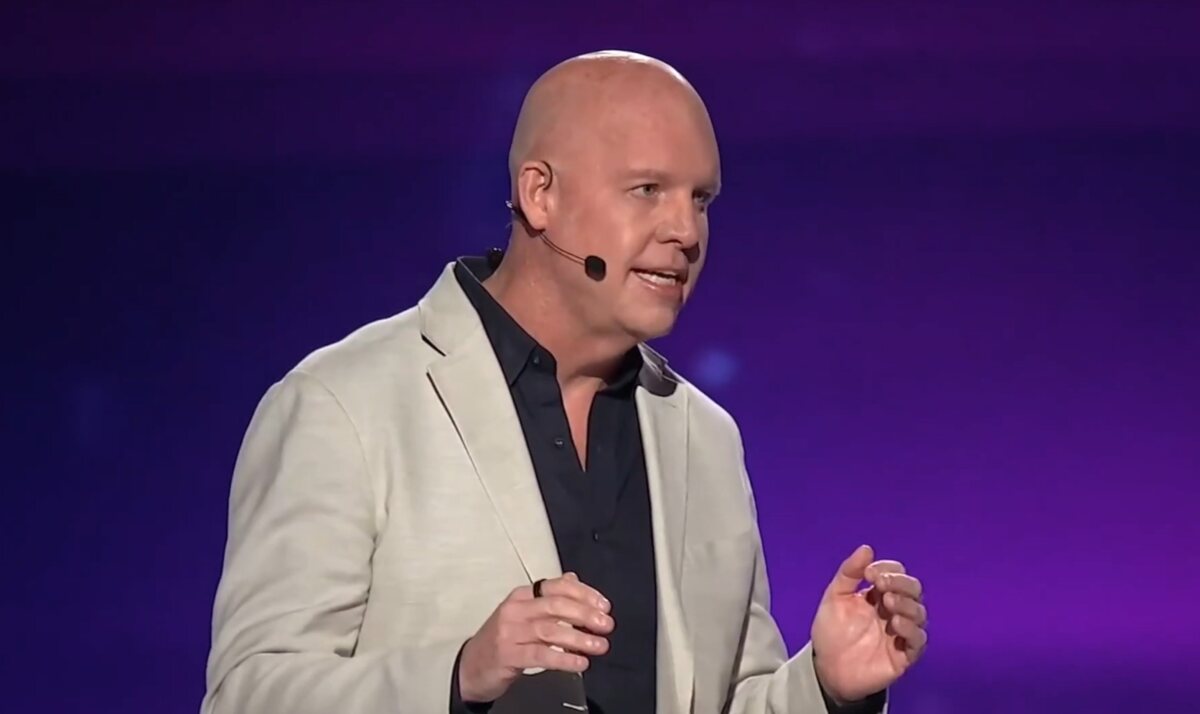
Rob T. LeeFounder, sicurity.ai

Created by Rob T. Lee
Created SIFT. Built for defenders. Now training the AI Security Engineer.
Created SIFT, the environment behind every sicurity.ai lab.
His aim is to help as many security practitioners as possible build the skills to secure AI systems.
Read why01 / The path
One role.
A clear path.
A launch course, a core pathway, one specialization, and adjacent courses.
Start here
PlannedSecuring and Investigating AI Agents
Map an agent's data and authority, enforce scoped tool actions, then contain and reconstruct an agent incident. First modules December 14, 2026.
0 of 9 modules accessible. Joining Skool does not unlock planned modules.
See the first courseCore pathway
ProposedAI Security Engineering
Seven courses from architecture and threat modeling to an integrated capstone.
0 of 40 modules accessible. Joining Skool does not unlock planned modules.
See the pathwaysSpecialization
ProposedML Lifecycle and Adversarial ML Security
For engineers securing datasets, training pipelines, and models.
0 of 6 modules accessible. Joining Skool does not unlock planned modules.
See the specializationAdjacent
ProposedAI for Security Practice
Use AI safely in security operations and authorized assessment.
0 of 12 modules accessible. Joining Skool does not unlock planned modules.
See adjacent coursesCourses are released one at a time. Each course page lists its status, prerequisites, labs, assessment, and what it does not teach.
Further ahead: additional fundamentals and DFIR courses. Details and any certification relationships will be published with each announcement.
Read the full role definitionInside the labs
The lab environment.
One fictional company, connected courses defending it. Each module is designed to end in something you build and can show.
Labs run on SIFT, the forensics workstation Rob T. Lee created, on your own machine. Each module states what it needs before you start.
Five design previews with sample data. Live labs open with each module.
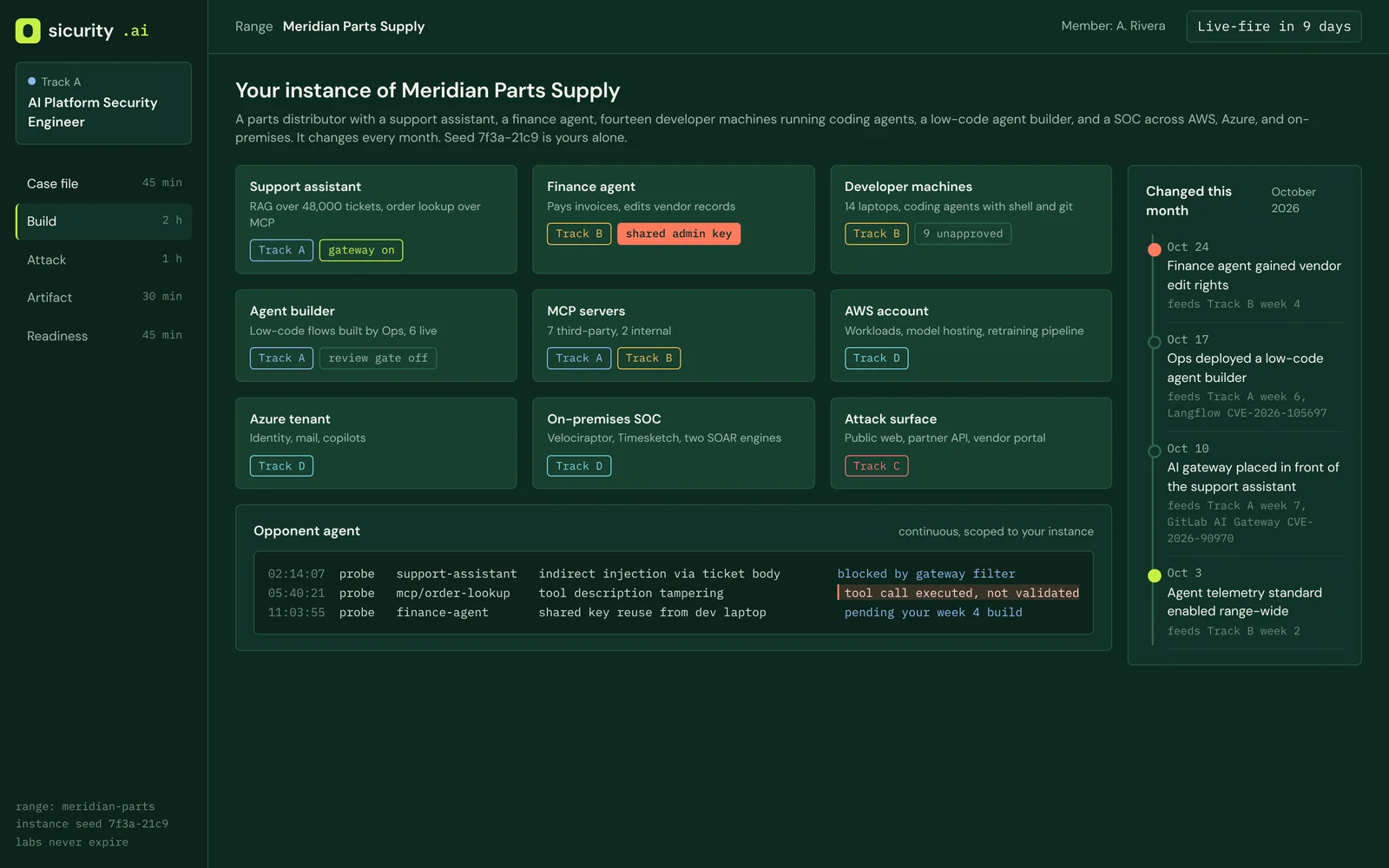
The shared range console. Explore the pathways
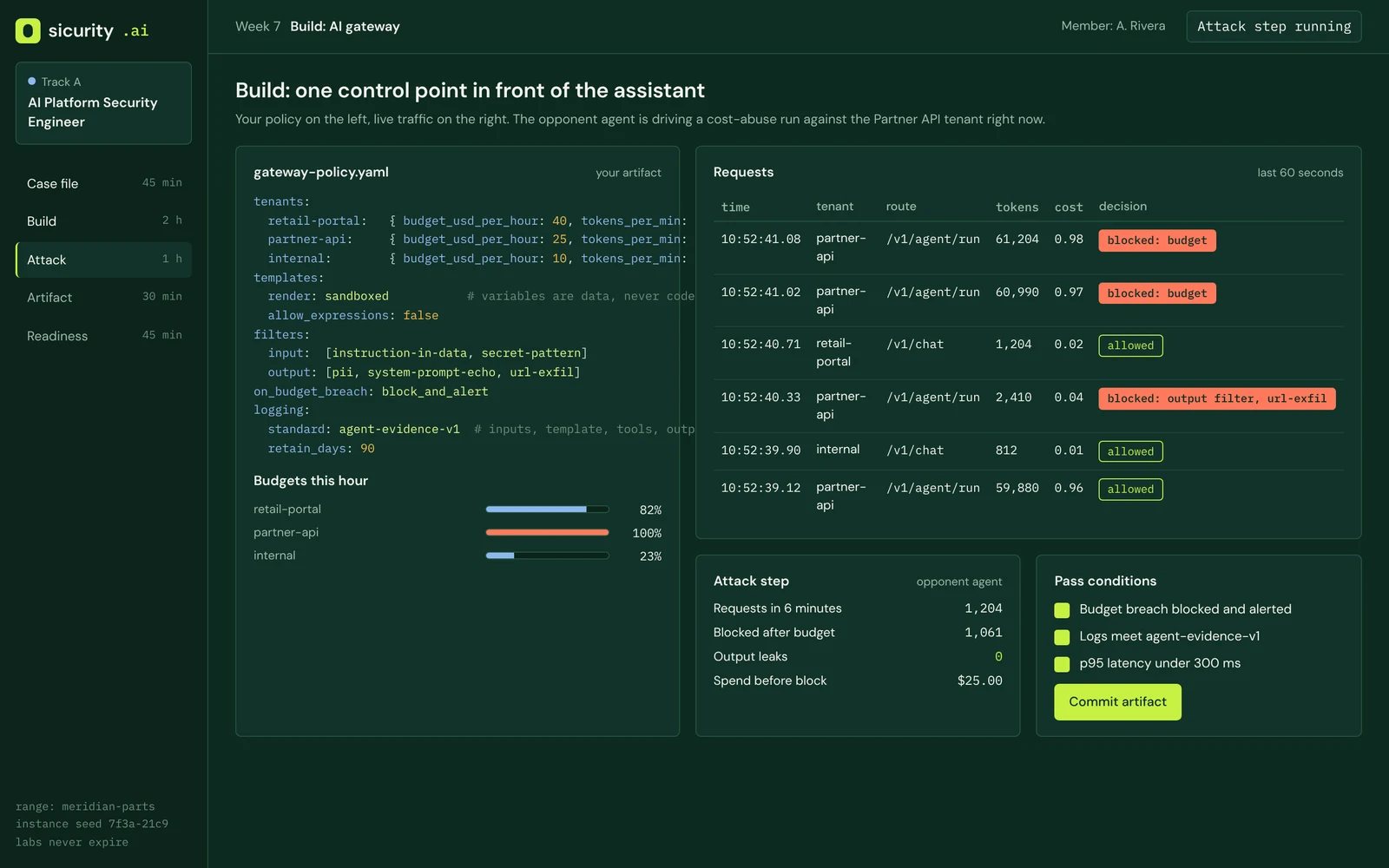
Budgets, filtering, and logging hold while a tenant is flooded.
LLM Application and Retrieval Security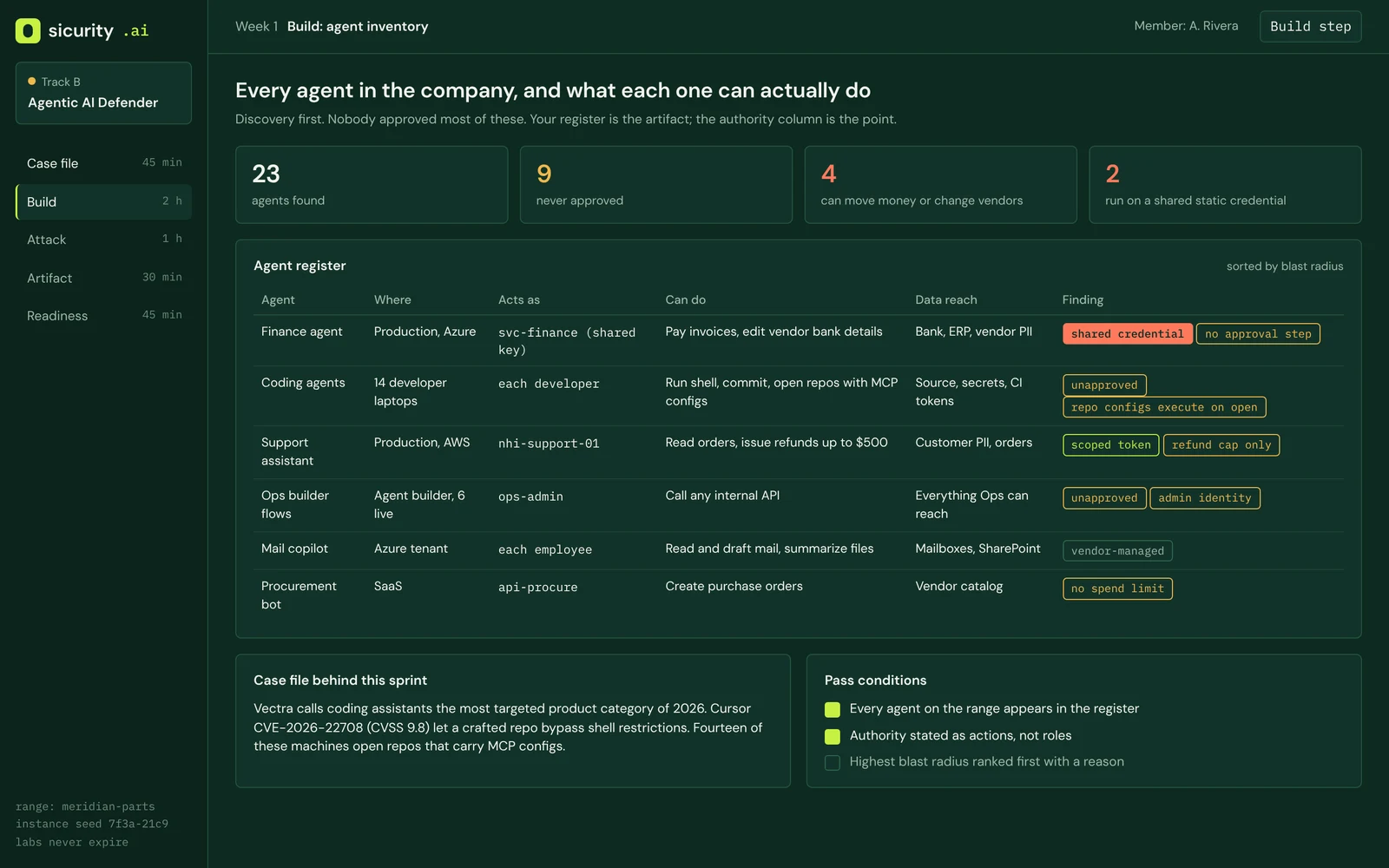
Every agent counted; authority written as actions.
Securing and Investigating AI Agents
Allowlist, approvals, and stop controls. Operational detail redacted.
AI-Assisted Security Assessment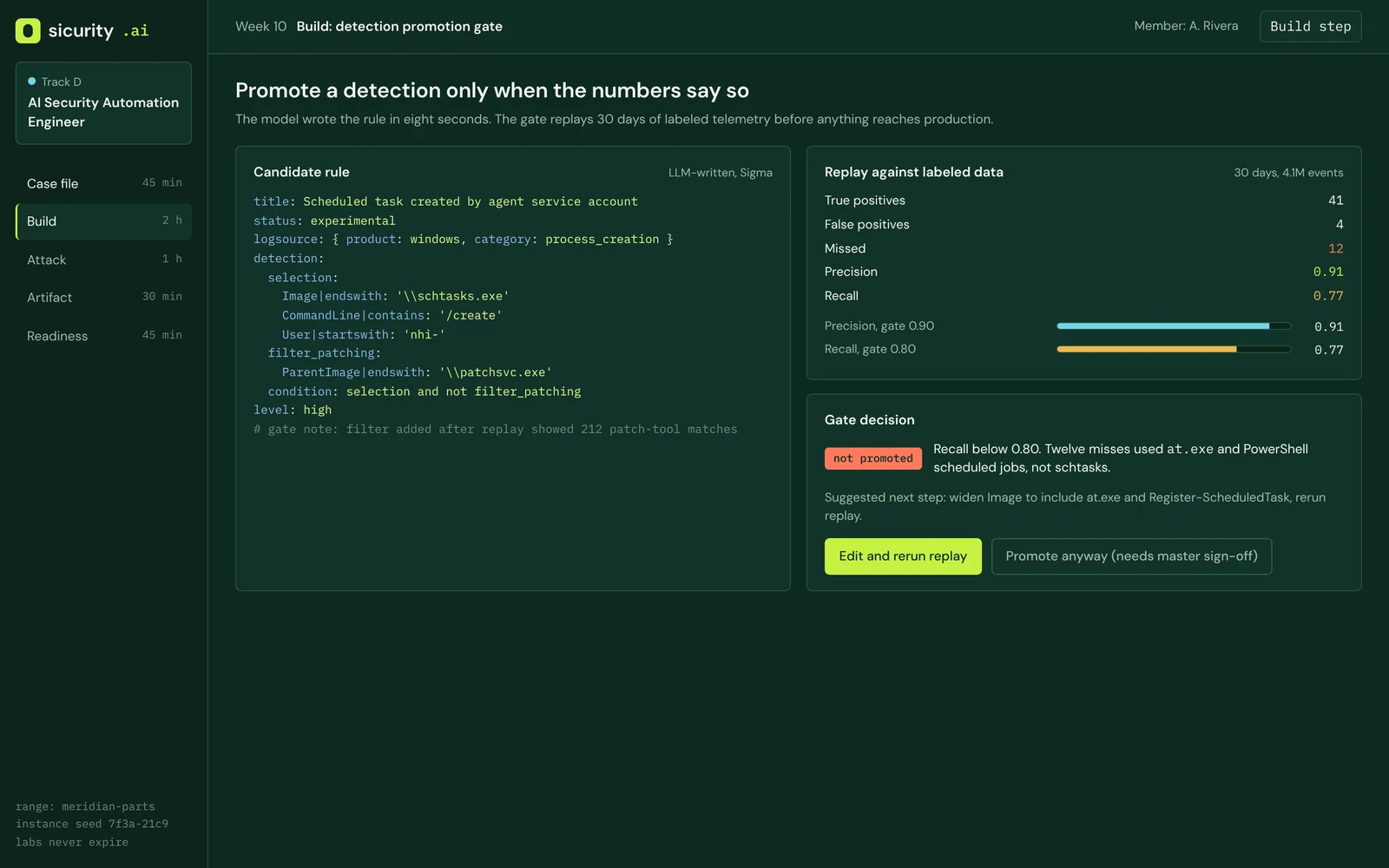
Precision and recall decide what ships.
AI-Assisted Security Operations EngineeringA manageable unit of work
Less seat time.
More hands on.
AI can assist. A human answers. Every released module will carry a signed record naming its author, AI contributions, and who verified the lab by hand.
01
Pick your course
Skool brings course content and community into one place. Open Classroom for released courses and modules. Use Community to ask questions and discuss what you are learning. The free foundation module listed on each course page, as it releases, plus community access.
02
Make time for the lab
Allow 2 to 4 hours per module, plus practice. Additional practice time varies. These are planning estimates, not measured completion times. Release dates are announced with each module.
03
Test your understanding
Practice with questions and lab artifacts. Graded assessments follow the published assessment standards. Final standards and rubrics will be published before assessment enrollment opens.
04
Keep the evidence
Review the module record and your completion documentation. Results reporting will follow real cohorts.
The human record
Accountability, attached.
- Module / version
- Available with first release
- Practitioner / author
- Named on each module
- AI contribution
- AI-assisted components disclosed
- Model / version
- Recorded for each use
- Verified by hand
- Lab runs and review record
- Sign-off / date
- Practitioner signature required
Illustrative. Signed records publish with each module.
One membership. Every released module in every course. Planned pricing: $149 a month or $1,290 a year.
View pricingBefore you commit
Fair questions.
Straight answers.
What is free, what is included, and what this training does not promise.
Why train to become an AI Security Engineer?
AI features, retrieval systems, agents, integrations, and model APIs cross application, cloud, identity, data, and response boundaries. Those risks can fall between teams when nobody owns the whole system. The AI Security Engineer connects the work: inventory and threat modeling, control design, testing, detection, and response. sicurity.ai is designed to help experienced security practitioners build that capability.
Is sicurity.ai open yet?
Not yet. First modules arrive December 14, 2026. Enrollment opens with the first modules. The rollout starts with Securing and Investigating AI Agents. Other courses follow as their modules are released. Release details will identify which modules are free or paid. We are launching on Skool to get the training into your hands without waiting for custom software. Lessons and community run at skool.com/sicurity. We will move to a custom sicurity.ai platform. Release dates are announced with each module.
What can I try for free?
The free foundation module listed on each course page, as it releases, plus community access.
What skills do the courses teach?
The core pathway covers AI system architecture, application and retrieval security, agent identity and tools, deployment and supply chain, evaluation and assessment, and detection and response. Optional courses cover ML lifecycle security and the safe use of AI in security operations and assessment.
Does one course make me an AI Security Engineer?
No. Each course builds and assesses part of the work. The launch course focuses on agents. Broader preparation requires the core pathway and professional experience.
Is the content written by AI?
A named practitioner owns the outline, judgment, lab verification, and sign-off. AI may help create lecture material, labs, or assessment items. The provenance record identifies those contributions, the model and version, and what the practitioner checked by hand. Human accountability does not mean hiding AI assistance.
Reviewed .