 sicurity.ai
E3 · AI for Security Practice (adjacent)
AI-Assisted Security Assessment
Use AI in authorized assessment while independently verifying findings, scope discipline, and AI's contribution.
Proposed
0 of 6 modules accessible. Joining Skool does not unlock planned modules.
At a glance
- Audience
- Existing authorized assessors.
- Prerequisites
- Networking
- Web testing
- Scripting
- Authorized-testing fundamentals
- Evidence handling
- Planned duration
- 20 hours. Assumes the entry requirements are met. Planning estimate, not a measured completion time. Per module: 2 to 4 hours, plus practice.
- Assessment
- Scoped assessment, evidence verification and rubric.
- What is free
- The free foundation module listed on each course page, as it releases, plus community access.
Job tasks this course prepares you for
- Keep every action inside the supplied assessment scope, as shown by the action log.
- Independently verify every reported finding.
- Show where AI improved or degraded the chosen task against a baseline.
- Produce an engagement report that discloses AI contribution and limitations.
Learning outcomes
- Keep every action inside the supplied assessment scope, as shown by the action log.
- Independently verify every reported finding.
- Show where AI improved or degraded the chosen task against a baseline.
- Produce an engagement report that discloses AI contribution and limitations.
Modules
00Select suitable tasksProposed
Topics
- analysis assistance, test-case generation, documentation, validation.
01Provider and data decisionsProposed
Topics
- approved services, redaction, retention, confidential material.
02Bounded assessment toolingProposed
Topics
- read-only defaults, explicit authorization, tool allowlists, stop controls.
03Validate outputProposed
Topics
- false findings, fabricated evidence, reproducibility, uncertainty.
04Measure contributionProposed
Topics
- baseline comparison, time, quality, coverage, cost.
05Defensive handoffProposed
Topics
- validated findings, remediation, detection opportunities, retest.
Labs and deliverables
- Conduct a bounded assessment of a synthetic application. Action logs, validated findings, a baseline comparison, and a defensive handoff.
Labs run on SIFT, the forensics workstation Rob T. Lee created, on your own machine. Each module states what it needs before you start. Each module confirms its setup requirements and any cloud or API costs before it opens. About the SIFT lab environment.
Assessment
Scoped assessment, evidence verification and rubric. A named assessor grades against the published rubric (rubric to be published before release).
Pass criteria
- Zero out-of-scope activity
- Zero unverified findings presented as established
- Reproducible evidence
- 80% rubric
Critical failures
- Unauthorized cross-tenant access
- Out-of-scope activity
- Uncontrolled destructive action
- Fabricated evidence
- Exposed credentials
What this course does not teach
- Does not replace penetration-testing fundamentals; not complete preparation for external certification exams; no unconstrained offensive operations.
Earlier module plan
Track CEarlier module plan (being reorganized)Planned
This plan was published before the curriculum was reorganized into courses. Modules may move, merge, or change before release. Status: Planned. Not accessible.
Original module table
| Module | Title | Summary | Status |
|---|---|---|---|
| 00 | Models for operatorsFree | Compare hosted, open-weight, and local model choices using a curated course dataset. | Planned |
| 01 | Engagement setup and AI operational security | Use a synthetic client dataset to define what may be shared with each model. | Planned |
| 02 | Profile a synthetic environment | Review a prebuilt, fictional set of company records. | Planned |
| 03 | Prioritize simulated findings | Use a fixed synthetic findings set and public advisory metadata to practice risk triage. | Planned |
| 04 | Review a patch safely | Inspect a prebuilt patch and a harmless reproduction in the isolated range. | Planned |
| 05 | Assess an isolated application | Evaluate a purpose-built training application with AI assistance. | Planned |
| 06 | Keep AI-assisted testing in scope | Review an agent’s proposed actions against a synthetic asset list and explicit allowlist. | Planned |
| 07 | Measure phishing resilience | Analyze prewritten, synthetic messages inside a private training fixture. | Deferred |
| 08 | Verify identity against synthetic media | Review a consented, clearly labeled synthetic-media scenario in a mock finance workflow. | Deferred |
| 09 | Analyze benign samples and detection gaps | Review prebuilt, inert files and harmless code samples inside the isolated range. | Planned |
| 10 | Validate defensive controls safely | Measure defensive controls against benign, prebuilt test signals in a non-production sandbox. | Planned |
| 11 | Controlled range exercise | Use only course-owned simulated systems under instructor-defined scope. | Planned |
| 12 | The engagement report | Deliver a report with scope, validation evidence from the synthetic range, measured model contribution, limitations, defensive recommendations, and a concise executive summary. | Planned |
Offensive AI Operator
The person who runs AI-augmented engagements and proves the uplift
Build the judgment to assess AI-enabled systems responsibly. Measure model contribution, validate findings in a controlled range, and return results as actionable defense.
You work through a fictional organization and a course-owned range. Each week examines how AI changes assessment quality and speed, then turns the learning into evidence, safer controls, and a defensive handoff. Written scope, human review, and synthetic data keep the work bounded.
Who it was written for
Penetration testers and red team operators whose clients are asking for AI-augmented engagements; vulnerability researchers who want AI discovery without producing slop; social engineering specialists who need to understand deepfake pretexts to defend against them; purple team leads who want attacks that come with detections.
What you would leave with
- A written scope and data-handling plan for simulated work
- A model-selection and contribution assessment
- A privacy-conscious profile of a synthetic environment
- A prioritized findings register with uncertainty noted
- Patch-review evidence and remediation recommendations
- A controlled test plan with allowlists, approvals, and stop criteria
- A phishing-resilience review using prewritten synthetic messages
- A consent-based identity-verification procedure for synthetic media
- Detection and containment recommendations for benign samples
- A final report with evidence, limitations, and defensive handoff
Planned practical work
Planned practical work includes scoped assessment, vulnerability triage and defensive validation. Malware creation, defensive bypass, phishing generation and offensive deepfake creation are outside this track.
Companion plan: Offensive AI Operator
Run a scoped engagement against the fictional company. Measure where AI improves the work, validate every finding, and deliver defensive artifacts alongside the engagement report.
Audience: Authorized penetration testers, red-team practitioners, and defenders who want to evaluate AI-assisted offensive workflows.
Prerequisites: Recommended: networking, web security, Python or shell scripting, and the fundamentals of authorized penetration testing. All exercises require the isolated training range.
Capstone: Deliver an engagement report showing validated findings, scope discipline, measured AI contribution, and a detection pack defenders can use.
| Module | Goal | Artifact | Related domains |
|---|---|---|---|
| 00 Foundations: model selection | Compare hosted, open-weight, and local models for authorized engagements. | A model-selection matrix. | Artificial Intelligence Fundamentals |
| 01 Engagement setup and AI operational security | Define client-data handling and log AI-assisted actions. | A model stack, data-handling rules, action log, and measurement protocol. | Artificial Intelligence Fundamentals |
| 02 Open-source target profiling | Analyze a seeded information corpus within the agreed scope. | A target profile and pretext inventory. | Using AI for OSINT |
| 03 Reconnaissance and triage | Evaluate AI-assisted prioritization against known range ground truth. | A retrieval-backed host-triage workflow. | Network Scanning and Vulnerability Detection |
| 04 Vulnerability validation | Separate reproducible findings from plausible but incorrect model output. | Patch-diff analysis, sandbox validation, and a triage standard. | Network Scanning and Vulnerability Detection |
| 05 Web application assessment | Evaluate AI-assisted reasoning on an intentionally vulnerable range application. | A validated finding and developer-ready remediation writeup. | Using AI for Web Exploitation |
| 06 Scoped offensive agents | Add hard scope limits and human approval points to an assessment workflow. | A scope-enforced assessment agent and action evidence. | Using AI for Web Exploitation; Network Scanning and Vulnerability Detection |
| 07 Simulated phishing and debrief | Measure a consented campaign against simulated users. | Campaign metrics and a defensive debrief. | Social Engineering Fundamentals; Creating Phishing Emails with AI |
| 08 Voice and video verification | Study consented synthetic-media scenarios and defensive verification. | A controlled pretext exercise and callback-verification protocol. | Audio, Image, and Video Deepfakes |
| 09 Sandboxed payload analysis | Evaluate AI-assisted malicious-software concepts only within the isolated lab. | A lab artifact and behavior analysis. | Malware Fundamentals; Creating Malicious Software with AI |
| 10 Defensive control evaluation | Test controls in the range and turn the results into detections. | Sigma and YARA rules evaluated against controlled variants. | Bypassing Defensive Controls |
| 11 Cross-track live-fire | Conduct authorized assessments of the other tracks’ range deployments. | A findings log scored on scope discipline and validated impact. | All objectives |
| 12 Practical assessment and evidence review | Present the engagement evidence and complete a timed practice assessment. | An engagement report, detection pack, and objective-tagged study index. | All objectives |
Screens are design previews with sample data, not live lab access or learner results.
00Models for operators
Compare hosted, open-weight, and local model choices using a curated course dataset. Record data-handling limits, cost, and safety considerations for a fictional engagement.
Learning objectives
01Engagement setup and AI operational security
Use a synthetic client dataset to define what may be shared with each model. Build a data-handling plan and an auditable record of model-assisted work. All exercise data stays inside the course environment.
Learning objectives
02Profile a synthetic environment
Review a prebuilt, fictional set of company records. Identify exposure patterns without contacting people, services, or organizations. Produce a privacy-conscious risk summary and remediation list.
Learning objectives
03Prioritize simulated findings
Use a fixed synthetic findings set and public advisory metadata to practice risk triage. Compare your prioritization against an instructor-provided answer key and explain uncertainty; no live scanning is involved.
Learning objectives
04Review a patch safely
Inspect a prebuilt patch and a harmless reproduction in the isolated range. Assess whether the change addresses the suspected defect, document evidence and uncertainty, and recommend remediation. No exploit code is published.
Learning objectives
DESIGN PREVIEW / SAMPLE DATA
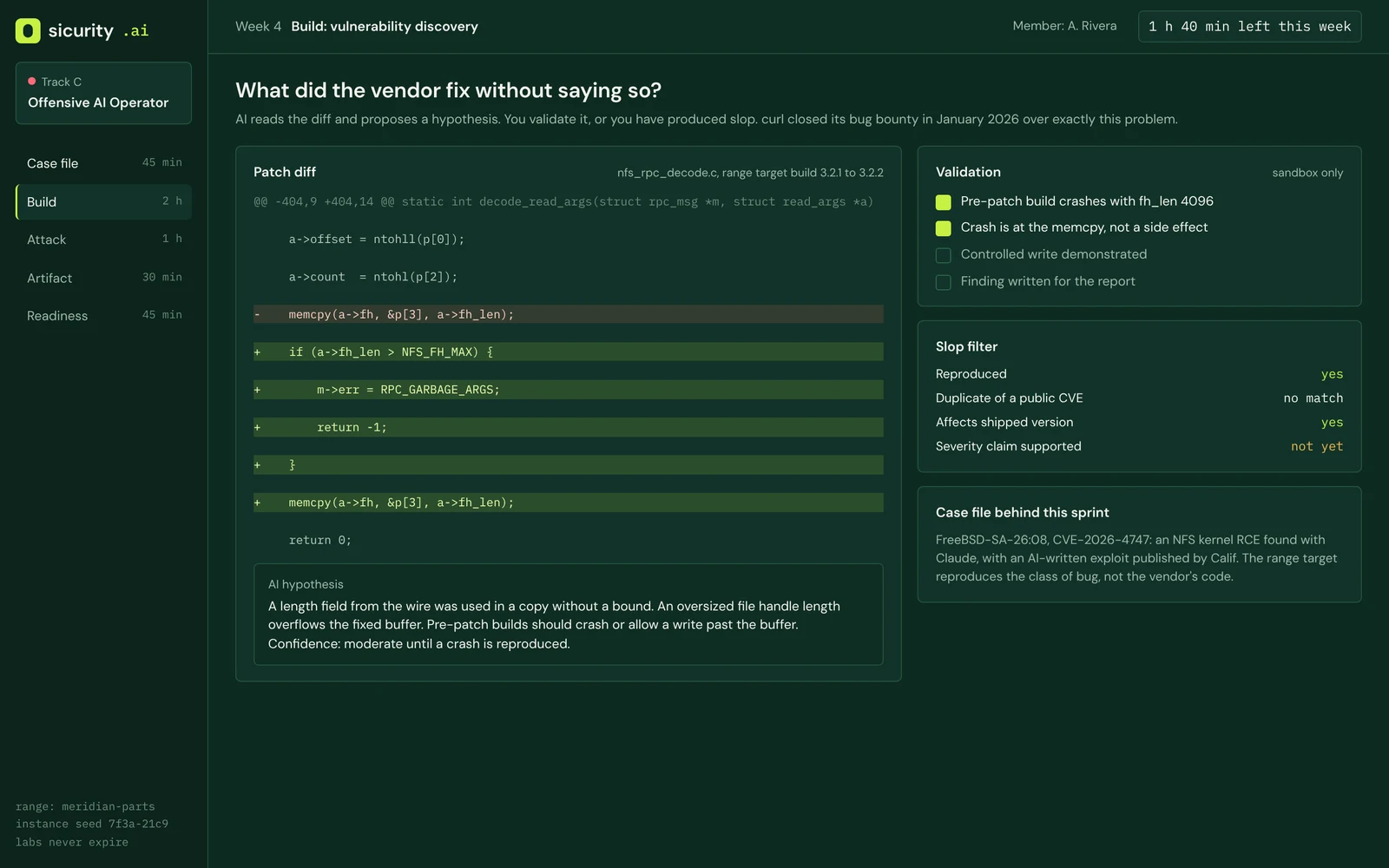
The patch-diff lab. The AI's hypothesis points at an unbounded copy; the sandbox confirms the crash at the memcpy. The slop filter still shows the severity claim as unsupported, so the finding is not yet reportable.
05Assess an isolated application
Evaluate a purpose-built training application with AI assistance. Verify candidate findings against safe test cases, record false positives, and write developer-focused remediation notes. The exercise does not target third-party or live systems.
Learning objectives
06Keep AI-assisted testing in scope
Review an agent’s proposed actions against a synthetic asset list and explicit allowlist. Require human approval for simulated actions, verify out-of-scope requests are blocked, and assess audit logging and stop controls. The preview omits operational attack steps.
Learning objectives
DESIGN PREVIEW / SAMPLE DATA
Public preview with operational target and exploit details redacted. The image represents a design mockup, not a live lab.
07Measure phishing resilienceDeferred
Deferred. Phishing-resilience expansion deferred.
Analyze prewritten, synthetic messages inside a private training fixture. Identify manipulation signals and design verification and awareness controls. No messages are sent to real people and no reusable lure generation is taught.
Learning objectives
08Verify identity against synthetic mediaDeferred
Deferred. Synthetic-media expansion deferred.
Review a consented, clearly labeled synthetic-media scenario in a mock finance workflow. Test independent callback and approval procedures; the exercise does not create impersonation audio or video.
Learning objectives
09Analyze benign samples and detection gaps
Review prebuilt, inert files and harmless code samples inside the isolated range. Focus on provenance, static analysis, detection coverage, and containment. The course does not create malware or stealth and persistence payloads.
Learning objectives
10Validate defensive controls safely
Measure defensive controls against benign, prebuilt test signals in a non-production sandbox. Improve detections and report false positives. The course does not teach evasion or bypass methods.
Learning objectives
11Controlled range exercise
Use only course-owned simulated systems under instructor-defined scope. Score scope compliance, evidence quality, and defensive handoff. No external targets are involved.
Learning objectives
DESIGN PREVIEW / SAMPLE DATA
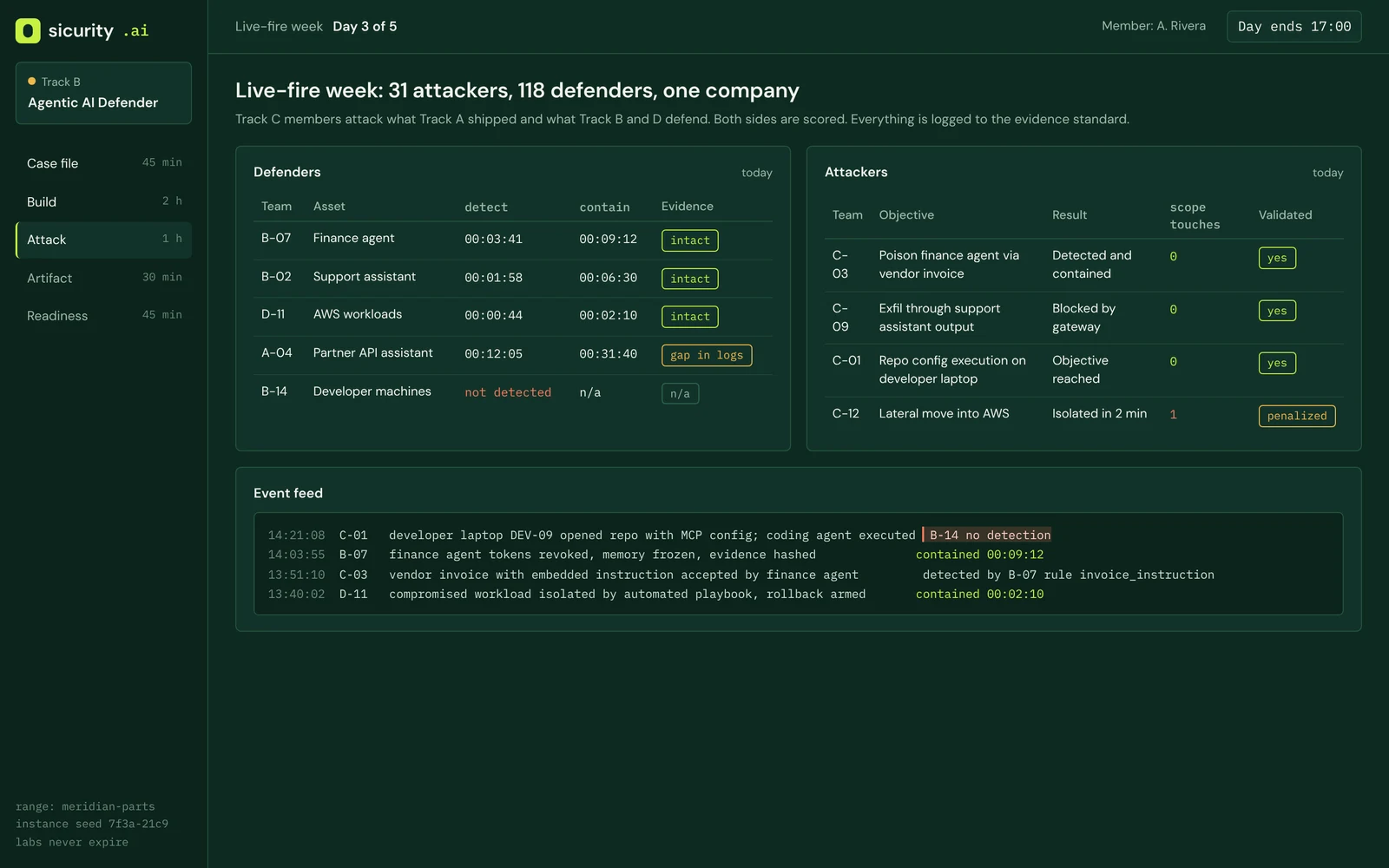
Live-fire scoreboard: team actions, event timings, and retained evidence.
12The engagement report
Deliver a report with scope, validation evidence from the synthetic range, measured model contribution, limitations, defensive recommendations, and a concise executive summary.
Learning objectives
DESIGN PREVIEW / SAMPLE DATA
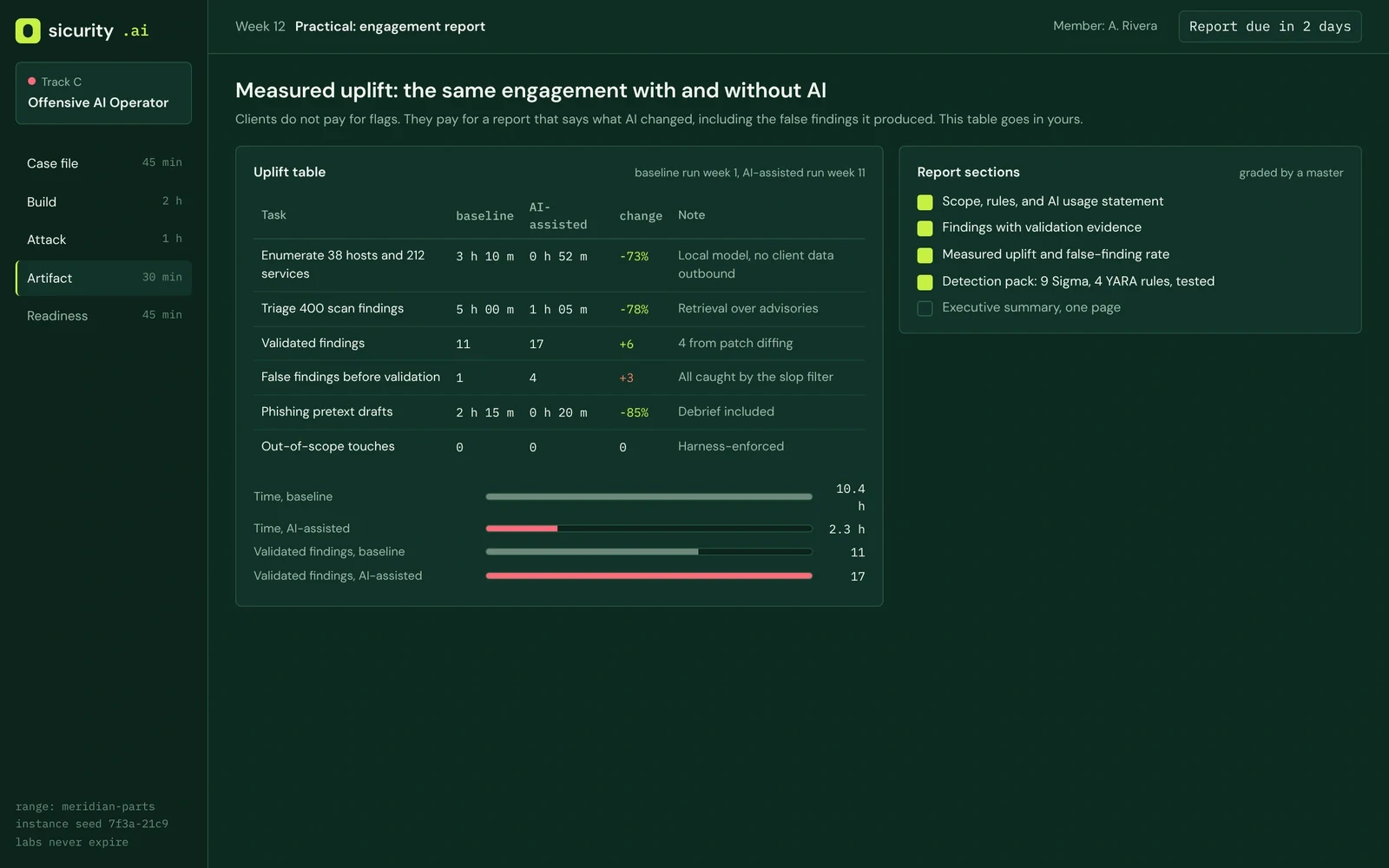
The uplift table compares baseline and AI-assisted work and records the false findings the slop filter caught.
Safe learning outcomes
These are planned sicurity.ai learning outcomes for authorized assessment and defensive validation. Malware creation, phishing generation, evasion and offensive deepfake creation are outside the track.
Sources for this plan
Primary-source review: October 31, 2026. References are linked below. Scenarios, scores, thresholds, and interface values are fictional course-design examples, not incident measurements or learner results. Modules and assessments remain planned until released.
OWASP risk names are referenced for identification. Course scenarios and proposed mappings are sicurity.ai interpretations, not official OWASP materials or endorsements.