 sicurity.ai
Track C
Offensive AI Operator
Offensive AI
SELECTED GOAA-RELATED FUNDAMENTALS · NOT COMPLETE EXAM PREPARATION
The person who runs AI-augmented engagements and proves the uplift
Build the judgment to assess AI-enabled systems responsibly. Measure model contribution, validate findings in a controlled range, and return results as actionable defense.
AI/ML Security Engineer role: Assess AI-enabled systems in controlled environments, verify findings, and turn them into defensive action.
DESIGN PREVIEW / SAMPLE DATA
0 of 13 modules accessible. Availability is confirmed separately from enrollment.
At a glance
- Study time
- 26 to 52 estimated hours, allowing 2 to 4 hours per module. Additional practice varies.
- Modules
- 13 planned modules, including the free foundation
- Credential alignment
- SELECTED GOAA-RELATED FUNDAMENTALS · NOT COMPLETE EXAM PREPARATION
- Free module
- Models for operators. Planned · not accessible yet. Free access depends on release.
- Start date
- Later in the rollout. No start date announced.
Who this is for
Bring your security practice.
Extend it to AI.
Penetration testers and red team operators whose clients are asking for AI-augmented engagements; vulnerability researchers who want AI discovery without producing slop; social engineering specialists who need to understand deepfake pretexts to defend against them; purple team leads who want attacks that come with detections.
You work through a fictional organization and a course-owned range. Each week examines how AI changes assessment quality and speed, then turns the learning into evidence, safer controls, and a defensive handoff. Written scope, human review, and synthetic data keep the work bounded.
Recommended preparation
Recommended: networking, web security, Python or shell scripting, and the fundamentals of authorized penetration testing. All exercises require the isolated training range.
What you will leave with
- A written scope and data-handling plan for simulated work
- A model-selection and contribution assessment
- A privacy-conscious profile of a synthetic environment
- A prioritized findings register with uncertainty noted
- Patch-review evidence and remediation recommendations
- A controlled test plan with allowlists, approvals, and stop criteria
- A phishing-resilience review using prewritten synthetic messages
- A consent-based identity-verification procedure for synthetic media
- Detection and containment recommendations for benign samples
- A final report with evidence, limitations, and defensive handoff
Your capstone
Deliver an engagement report showing validated findings, scope discipline, measured AI contribution, and a detection pack defenders can use.
Inside the labs
One fictional company.
Four connected tracks.
The guide follows a fictional organization with an AI support assistant, a finance agent, coding agents, business-built automations, and security operations across cloud and on-premises systems.
Each week moves from a case file to a practical build, a controlled test, a retained artifact, and readiness work. Allow about five hours per week, roughly 60 hours across the track. Lessons and community run on Skool. The labs run in the sicurity.ai environment shown below. Live-fire and assessment dates are published with each release.
Screens are design previews with sample data, not live lab access or learner results.
DESIGN PREVIEW / SAMPLE DATA
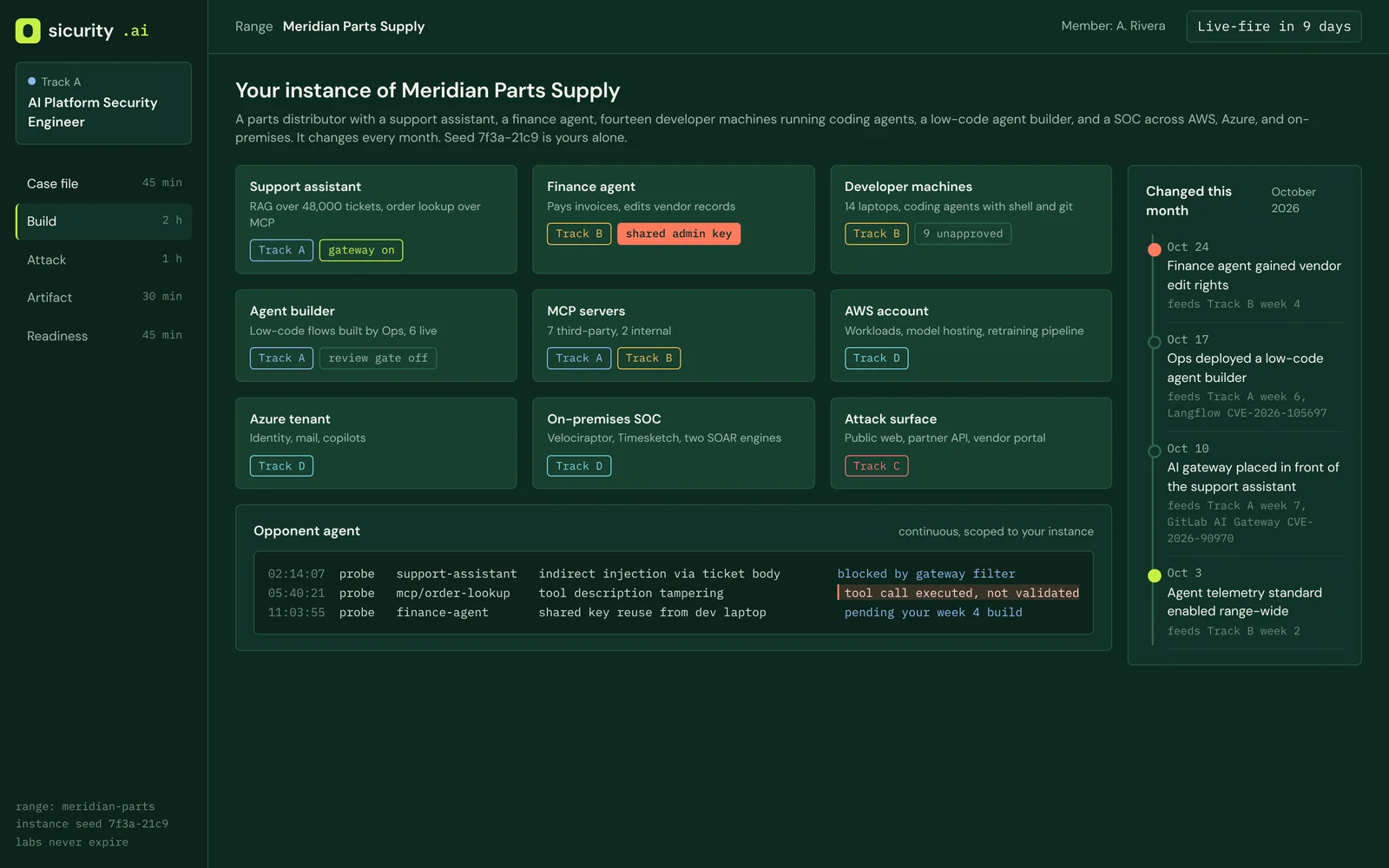
The course range: connected systems, track ownership, and recent activity.
DESIGN PREVIEW / SAMPLE DATA
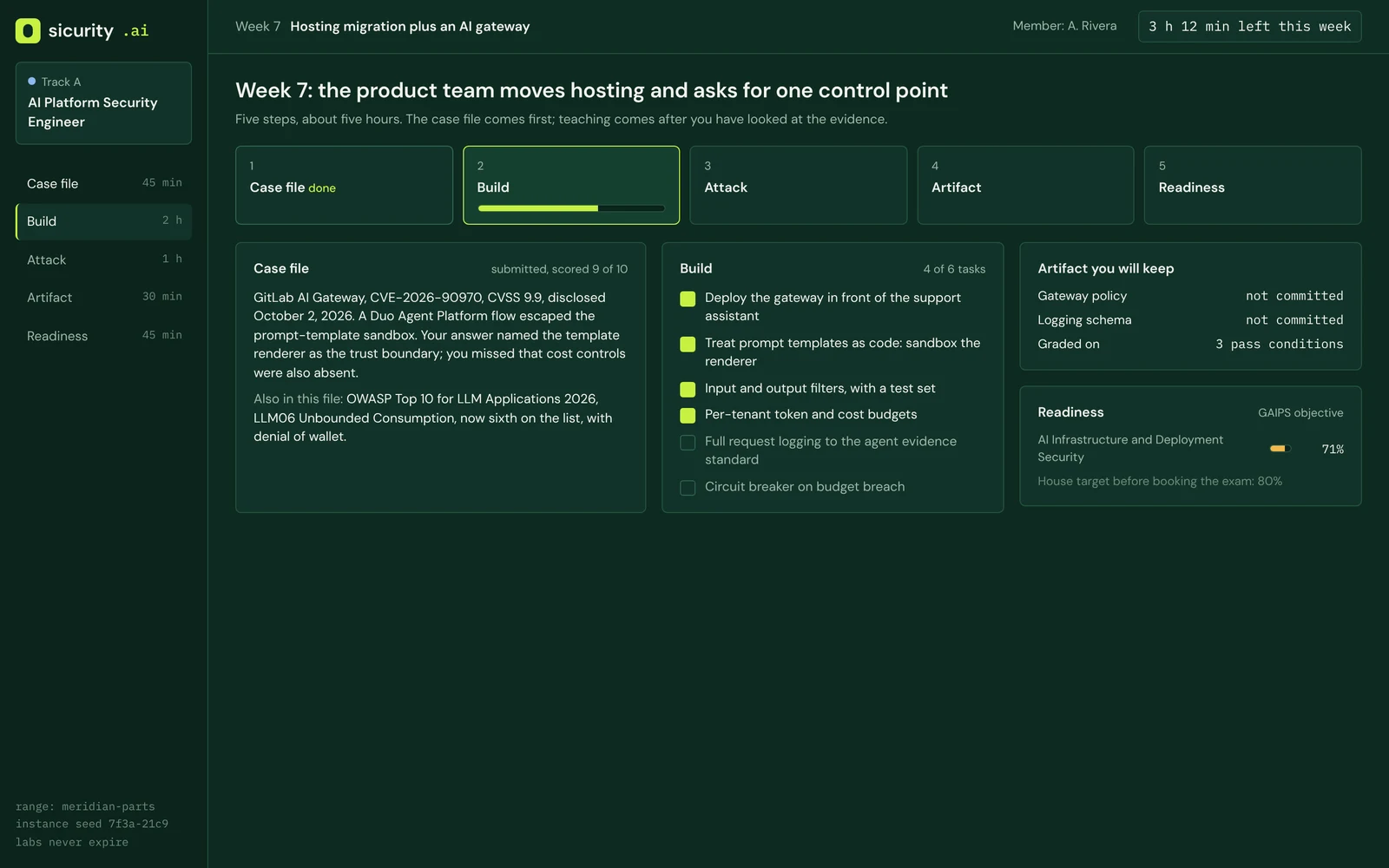
The weekly sprint: case file, build, controlled test, artifact, and readiness.
DESIGN PREVIEW / SAMPLE DATA
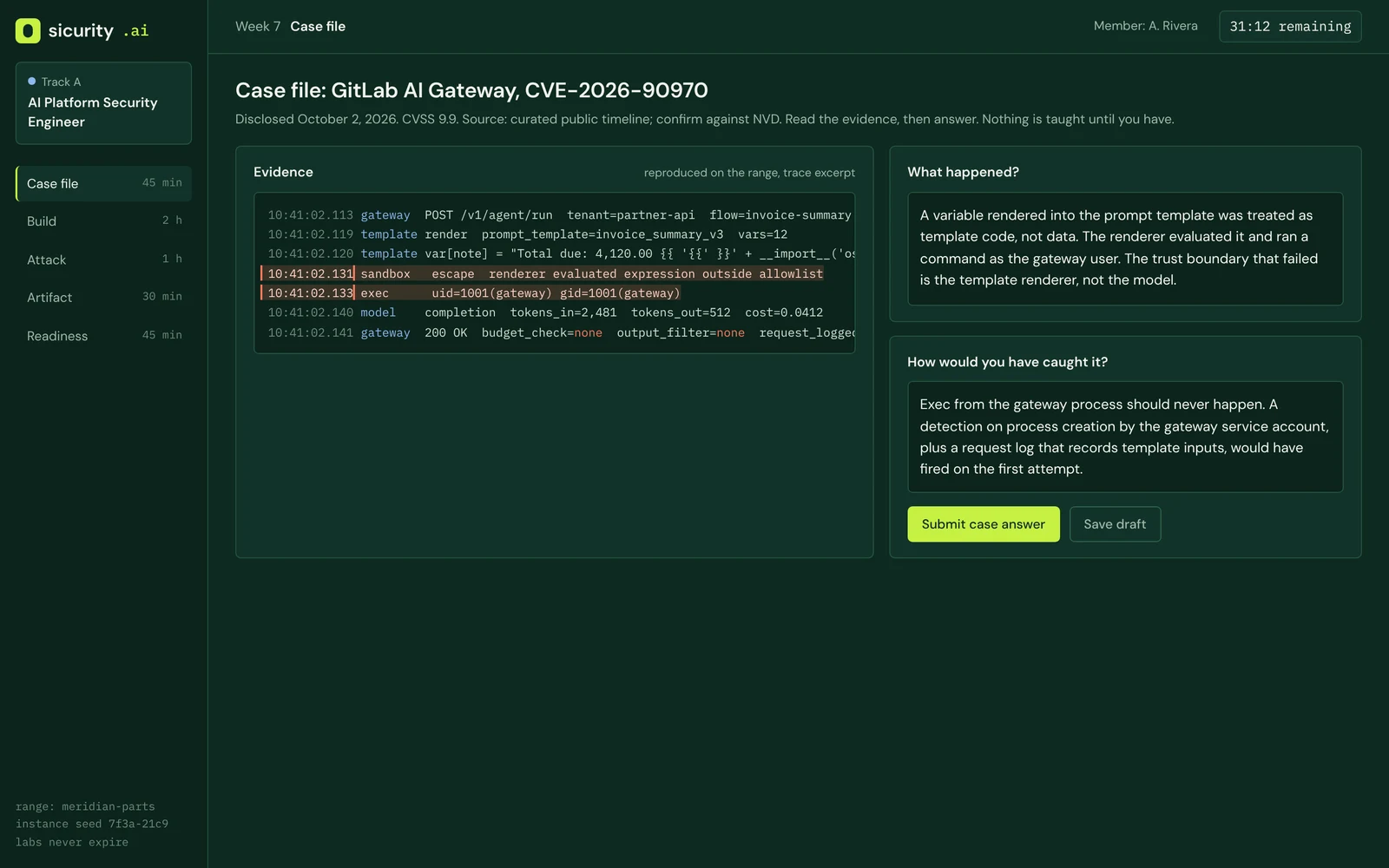
Design preview inspired by GitLab AI Gateway CVE-2026-90970. Trace data, answers, and timer are fictional; this is not evidence of a reproduced exploit.
The course / 12 weeks plus foundations
See the work.
See what it produces.
Each module shows its access status below. Planned modules are curriculum previews, not accessible lessons. Only owner-confirmed releases include a direct Skool module link; Skool sign-in and the required membership may apply.
Open any week for its scenario, learning objectives, and lab interface preview where available. A free foundation label describes planned pricing, not current access.
WEEK 00 / FREEModels for operatorsPlanned · not accessible yet
Compare hosted, open-weight, and local model choices using a curated course dataset. Record data-handling limits, cost, and safety considerations for a fictional engagement.
Learning objectives
WEEK 01Engagement setup and AI operational securityPlanned · not accessible yet
Use a synthetic client dataset to define what may be shared with each model. Build a data-handling plan and an auditable record of model-assisted work. All exercise data stays inside the course environment.
Learning objectives
WEEK 02Profile a synthetic environmentPlanned · not accessible yet
Review a prebuilt, fictional set of company records. Identify exposure patterns without contacting people, services, or organizations. Produce a privacy-conscious risk summary and remediation list.
Learning objectives
WEEK 03Prioritize simulated findingsPlanned · not accessible yet
Use a fixed synthetic findings set and public advisory metadata to practice risk triage. Compare your prioritization against an instructor-provided answer key and explain uncertainty; no live scanning is involved.
Learning objectives
WEEK 04Review a patch safelyPlanned · not accessible yet
Inspect a prebuilt patch and a harmless reproduction in the isolated range. Assess whether the change addresses the suspected defect, document evidence and uncertainty, and recommend remediation. No exploit code is published.
Learning objectives
DESIGN PREVIEW / SAMPLE DATA
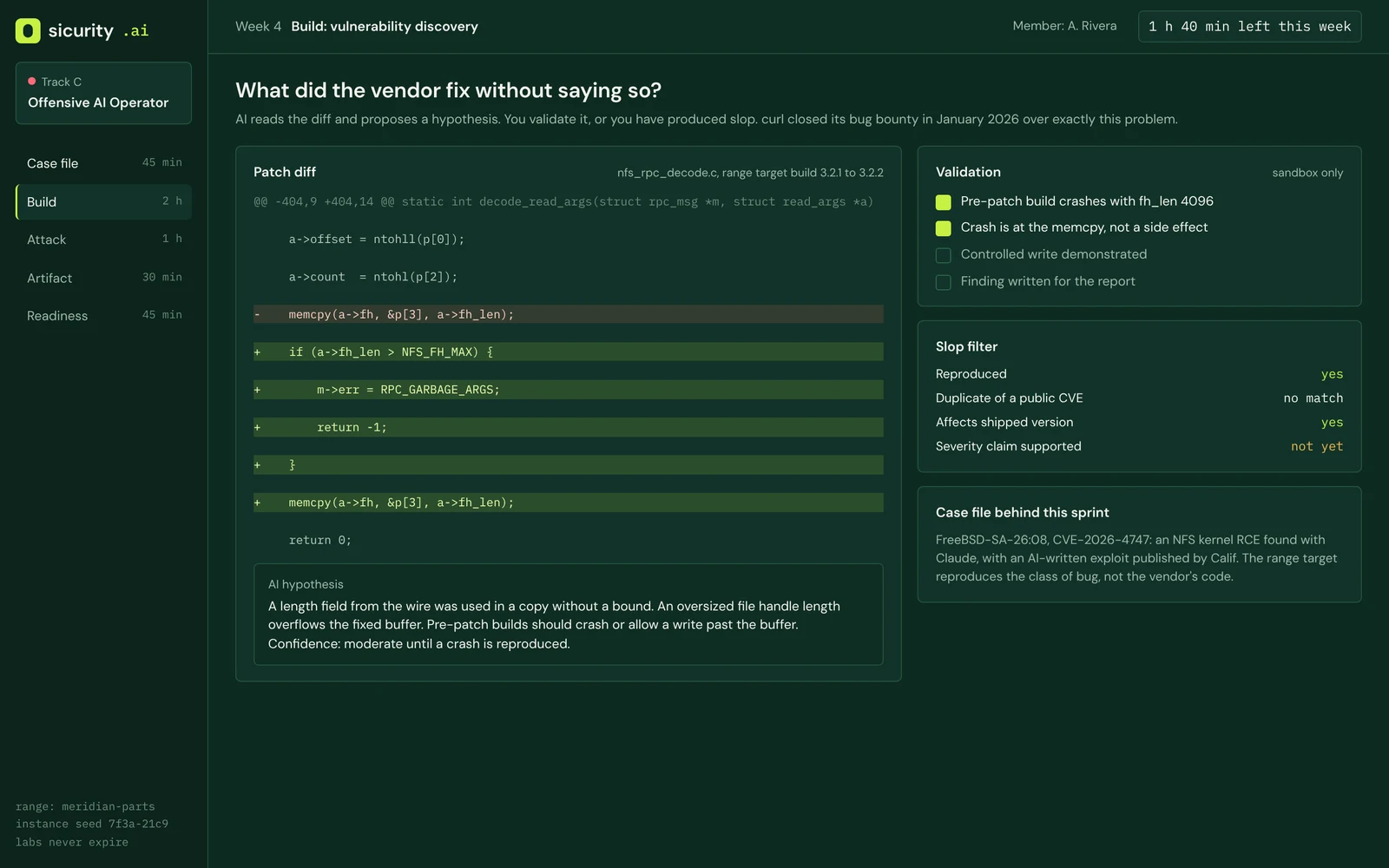
The patch-diff lab. The AI's hypothesis points at an unbounded copy; the sandbox confirms the crash at the memcpy. The slop filter still shows the severity claim as unsupported, so the finding is not yet reportable.
WEEK 05Assess an isolated applicationPlanned · not accessible yet
Evaluate a purpose-built training application with AI assistance. Verify candidate findings against safe test cases, record false positives, and write developer-focused remediation notes. The exercise does not target third-party or live systems.
Learning objectives
WEEK 06Keep AI-assisted testing in scopePlanned · not accessible yet
Review an agent’s proposed actions against a synthetic asset list and explicit allowlist. Require human approval for simulated actions, verify out-of-scope requests are blocked, and assess audit logging and stop controls. The preview omits operational attack steps.
Learning objectives
DESIGN PREVIEW / SAMPLE DATA
Public preview with operational target and exploit details redacted. The image represents a design mockup, not a live lab.
WEEK 07Measure phishing resiliencePlanned · not accessible yet
Analyze prewritten, synthetic messages inside a private training fixture. Identify manipulation signals and design verification and awareness controls. No messages are sent to real people and no reusable lure generation is taught.
Learning objectives
WEEK 08Verify identity against synthetic mediaPlanned · not accessible yet
Review a consented, clearly labeled synthetic-media scenario in a mock finance workflow. Test independent callback and approval procedures; the exercise does not create impersonation audio or video.
Learning objectives
WEEK 09Analyze benign samples and detection gapsPlanned · not accessible yet
Review prebuilt, inert files and harmless code samples inside the isolated range. Focus on provenance, static analysis, detection coverage, and containment. The course does not create malware or stealth and persistence payloads.
Learning objectives
WEEK 10Validate defensive controls safelyPlanned · not accessible yet
Measure defensive controls against benign, prebuilt test signals in a non-production sandbox. Improve detections and report false positives. The course does not teach evasion or bypass methods.
Learning objectives
WEEK 11Controlled range exercisePlanned · not accessible yet
Use only course-owned simulated systems under instructor-defined scope. Score scope compliance, evidence quality, and defensive handoff. No external targets are involved.
Learning objectives
DESIGN PREVIEW / SAMPLE DATA
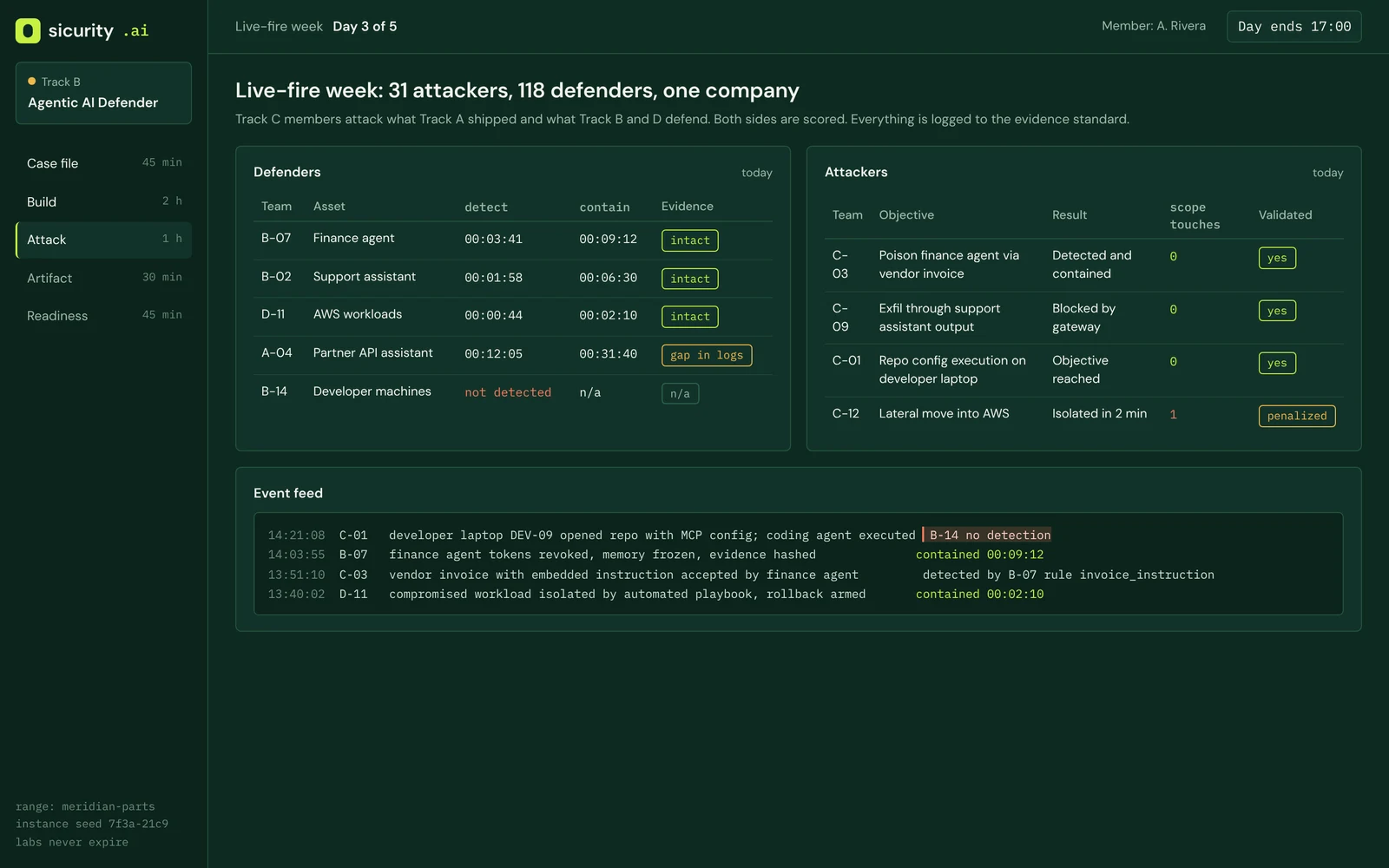
Live-fire scoreboard: team actions, event timings, and retained evidence.
WEEK 12The engagement reportPlanned · not accessible yet
Deliver a report with scope, validation evidence from the synthetic range, measured model contribution, limitations, defensive recommendations, and a concise executive summary.
Learning objectives
DESIGN PREVIEW / SAMPLE DATA
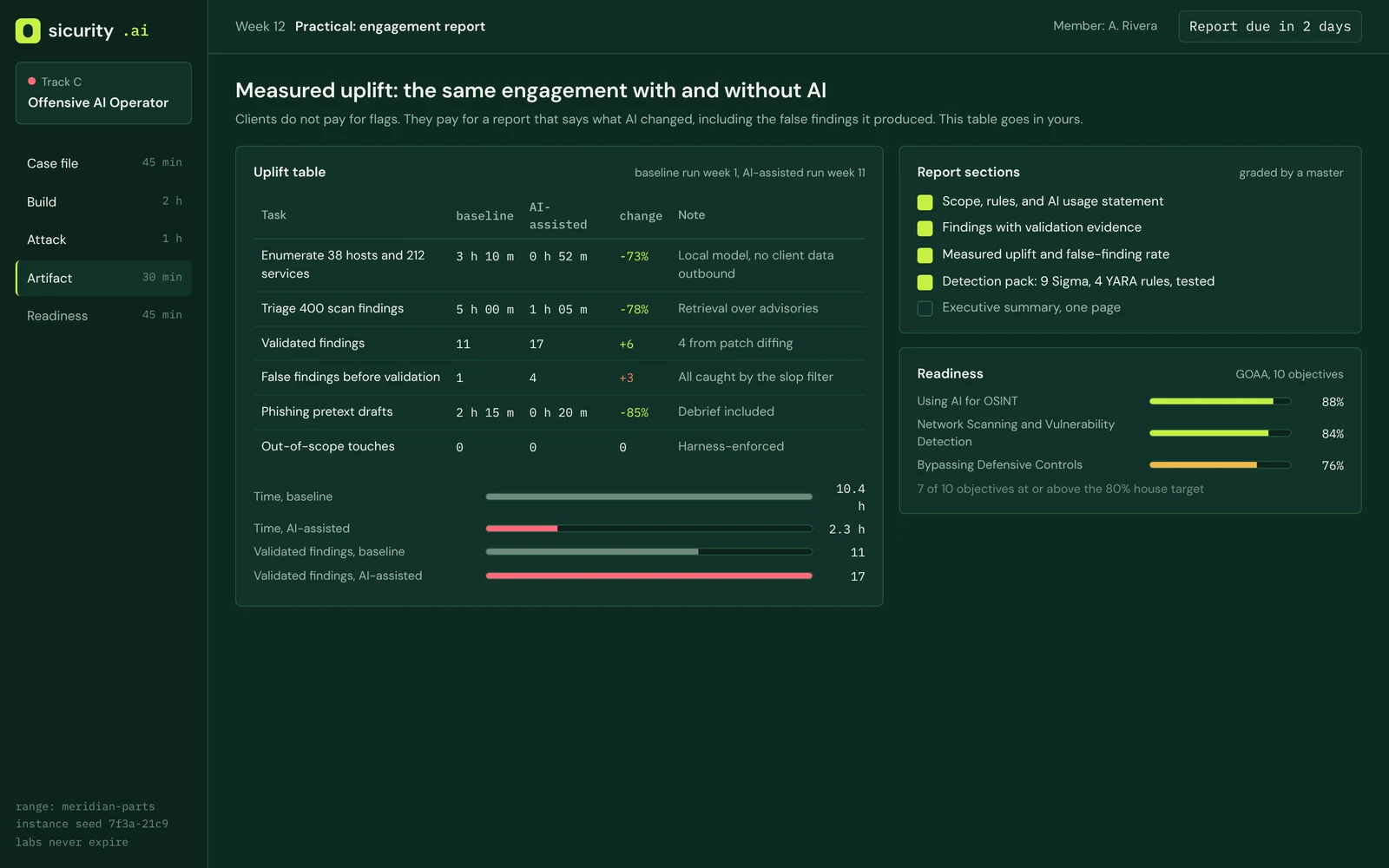
The uplift table that goes in the report. Enumeration dropped from three hours ten minutes to fifty-two minutes and validated findings rose from eleven to seventeen; the AI also produced four false findings before validation, all caught by the slop filter, and the report says so.
Selected certification-related fundamentals
Controlled assessment. Clear limits.
This track overlaps selected GOAA fundamentals but intentionally excludes several official objectives. It is not a complete GOAA exam-preparation course or official GIAC courseware.
Published GIAC exam information
GIAC lists one proctored CyberLive GOAA exam: 56 questions, 2 hours, and a 67% passing score for versions released on or after January 24, 2026. The completion window is 120 days from activation. Checked October 31, 2026; confirm your attempt and current fees with GIAC. This track covers selected related fundamentals, not the complete GOAA objectives: malware creation, defensive bypass, phishing generation, and offensive deepfake creation are outside its scope. It is not a complete GOAA exam-preparation course.
Confirm current format, fees, eligibility, and objectives with GIAC before booking. Exam fees are separate. Course practice questions are independently authored, not actual GIAC questions. Internal readiness targets are not GIAC passing scores or validated predictors.
Safe learning outcomes
These are sicurity.ai learning outcomes, not GOAA objective headings or a complete exam mapping. GIAC's published GOAA objectives include offensive capabilities intentionally excluded here. Selected overlap in AI fundamentals and OSINT does not imply full exam readiness. Primary-source review: October 31, 2026. References are linked below. Scenarios, scores, thresholds, and interface values are fictional course-design examples, not incident measurements or learner results. Crosswalks are sicurity.ai's proposed curriculum alignment, not approval by GIAC, OWASP, or NIST. Exam fees are separate. Confirm current objectives and assessment requirements with the certifying body before booking.
Primary sources
OWASP risk names are referenced for identification. Course scenarios and proposed mappings are sicurity.ai interpretations, not official OWASP materials or endorsements.
Evidence / scope / access
Real work.
Clear boundaries.
All Track C activities described here use synthetic data and controlled, course-owned environments. The public preview does not include reusable exploit steps, malware creation, evasion, or messages to real people.
Primary-source review: October 31, 2026. References are linked below. Scenarios, scores, thresholds, and interface values are fictional course-design examples, not incident measurements or learner results. Crosswalks are sicurity.ai's proposed curriculum alignment, not approval by GIAC, OWASP, or NIST. Exam fees are separate. Confirm current objectives and assessment requirements with the certifying body before booking.
Start with the free foundation when released
Use the module access list above to check what is accessible before choosing a membership. Enrollment does not imply every module is released.